Sharpening the Arsenal by Gurmeet Kanwal
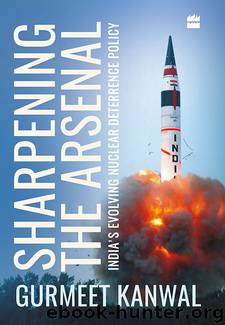
Author:Gurmeet Kanwal
Language: eng
Format: epub
Tags: null
Publisher: HarperCollins Publishers India
Published: 2017-03-05T16:00:00+00:00
9
Indo-US Nuclear Agreement: Impact on Deterrence
The Indian economy is the fastest growing among the G-20 economies.1 If India’s GDP is to continue to grow at about 8 per cent per annum over a secular time frame, India’s energy availability must grow at 6 per cent per annum. This cannot be achieved by conventional means alone and, hence, India and the United States signed a landmark strategic agreement during Prime Minister Manmohan Singh’s summit meeting with President George W. Bush in Washington, DC, in July 2005. President Bush declared India a ‘responsible state with advanced nuclear technology’ and signalled America’s acceptance of India’s status as a de facto nuclear weapons state outside the Non-Proliferation Treaty (NPT). The US agreed to cooperate with India to supply civilian nuclear technology and nuclear fuel for power generation by amending its domestic legislation that bans such supplies to non-NPT states.
The ‘US–India Civil Nuclear Cooperation Agreement’ followed several rounds of intense bilateral negotiations to agree on the Next Steps to Strategic Partnership (NSSP) and the Defence Framework Agreement signed by Defence Minister Pranab Mukherjee and Defense Secretary Donald Rumsfeld on 28 June 2005; the Defence Framework Agreement was renewed for another ten years in June 2015. It has helped to further cement the increasingly close defence cooperation between the US and India, including joint patrolling of the Sea Lanes of Communication (SLOCs) in the northern Indian Ocean up to the mouth of the Strait of Malacca.
The nuclear cooperation agreement raised the newly established strategic partnership between the two countries to a higher level of collaboration after several decades of mutual suspicion. In specific terms, the nuclear deal will enable India to obtain enriched uranium to fuel its nuclear reactors, acquire nuclear reactor technology from the international market and participate in international nuclear research and development in return for India’s acceptance of a stringent international safeguards regime. India has agreed to place sixteen nuclear installations under international safeguards. However, these do not include those nuclear facilities that are involved in the production of fissile material and other components of India’s strategic weapons programme. The positive spin-offs of the agreement are already beginning to take shape. France and Russia declared their willingness to offer nuclear reactors and fuel to India soon after the Nuclear Suppliers Group (NSG) amended its guidelines in September 2008 to make an exception for India. India has been invited to and has joined the International Thermo-Nuclear Experimental Reactor (ITER) initiative on fusion energy.2 India was also invited to join the Global Nuclear Energy Partnership (GNEP). The GNEP is a partnership of countries aiming to ensure that new nuclear energy initiatives meet the highest standards of safety, security and non-proliferation.
Opponents of the nuclear deal are of the view that it is tantamount to giving India a backdoor entry into the NPT without a binding commitment to meet its non-proliferation obligations. However, the Indian case is that India has a clean non-proliferation record and that the country has unilaterally adhered to all the obligations that are enjoined on NPT member states even though it has not formally signed the agreement.
Download
This site does not store any files on its server. We only index and link to content provided by other sites. Please contact the content providers to delete copyright contents if any and email us, we'll remove relevant links or contents immediately.
| Automotive | Engineering |
| Transportation |
Whiskies Galore by Ian Buxton(42078)
Introduction to Aircraft Design (Cambridge Aerospace Series) by John P. Fielding(33175)
Small Unmanned Fixed-wing Aircraft Design by Andrew J. Keane Andras Sobester James P. Scanlan & András Sóbester & James P. Scanlan(32835)
Craft Beer for the Homebrewer by Michael Agnew(18284)
Turbulence by E. J. Noyes(8112)
The Complete Stick Figure Physics Tutorials by Allen Sarah(7422)
The Thirst by Nesbo Jo(7002)
Kaplan MCAT General Chemistry Review by Kaplan(6986)
Bad Blood by John Carreyrou(6669)
Modelling of Convective Heat and Mass Transfer in Rotating Flows by Igor V. Shevchuk(6494)
Weapons of Math Destruction by Cathy O'Neil(6362)
Learning SQL by Alan Beaulieu(6341)
Man-made Catastrophes and Risk Information Concealment by Dmitry Chernov & Didier Sornette(6138)
Digital Minimalism by Cal Newport;(5835)
Life 3.0: Being Human in the Age of Artificial Intelligence by Tegmark Max(5616)
iGen by Jean M. Twenge(5453)
Secrets of Antigravity Propulsion: Tesla, UFOs, and Classified Aerospace Technology by Ph.D. Paul A. Laviolette(5412)
Design of Trajectory Optimization Approach for Space Maneuver Vehicle Skip Entry Problems by Runqi Chai & Al Savvaris & Antonios Tsourdos & Senchun Chai(5140)
Pale Blue Dot by Carl Sagan(5076)
